



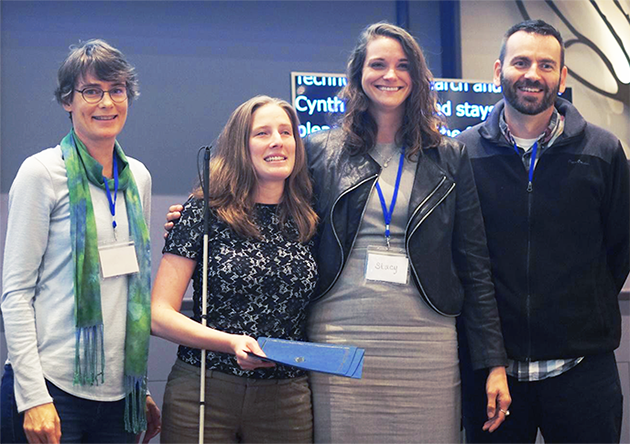

Image of Joanna McGrenere

Research
Teaching
Students
Publications
Brief Bio
Professional Activities
Directions to my Office

Joanna McGrenere
Associate Professor
Computer Science
University of British Columbia


Email: joanna @ cs.ubc.ca
Office: ICICS/CS X665 (directions)
Phone: 604 827-5201
Fax: 604 822-4231 

Snailmail:
201-2366 Main Mall
Department of Computer Science
The University of British Columbia
Vancouver, B.C., V6T 1Z4
Canada


Research

My research interests fall within the area of Human-Computer Interaction (HCI). While I am interested in many topics in HCI, my research has focused on the following sub-areas:

Computer technology is complex and people are complex. And the fit between this technology and the people who use it is often awkward. Although there is always room for general improvements in the design of any given software application or device, most individuals would benefit from having the application or device designed to their own specific needs. For example, users have different tasks, skills, knowledge, and abilities. Designing technology to accommodate such individual differences is difficult. There are two main approaches to accommodating individual differences in design, namely, adaptive and adaptable interface designs. In an adaptive design, the system modifies its own interface based on what it knows about the user. In adaptable designs it is the user who makes the adaptations. Both approaches have benefits and drawbacks. The objective of my research is to explore the boundaries between adaptive and adaptable technology and to derive generalizable design principles.

In the Aphasia Project I am exploring customizability in the context of designing interfaces for people who have aphasia, a cognitive disorder affecting a person's speech and language. The variability among individuals with aphasia is extremely large and technology needs to be highly adaptable in order to accommodate this variability. The main goal of the Aphasia Project is to create technology to support people with aphasia in their daily life. We work in conjunction with people who have aphasia; they share their expertise of living/communicating with aphasia with us to help us explore communication and high-level applications that combine images, text, and sound. Many of our applications are developed for state of the art mobile technologies, such as personal digital assistants and tablet PCs. I lead the CHI 2006 workshop on Designing Technology for People with Cognitive Impairments that explored the design and evaluation of various cognitive technologies.

Computer Supported Cooperative Work (CSCW) focuses on technologies that support group activity, namely groupware. My current work in that area is centered on providing better support for asynchronous collaborative writing through structured annotations. I am also investigating novel ways to support groups of users who are collaborating in realtime from a distance using a shared application. In the past, I have worked on support for children collaborating face-to-face with a shared computer.

top of page


Teaching


Since arriving at UBC, I have spent substantial effort revising and creating new HCI curriculum as well as new facilities to support that curriculum. My general philosophy of HCI teaching is that students learn best while doing hands-on team work, both large term projects and short activities. This philosophy is evident both in my graduate and undergraduate teaching. For example, I developed a new Advanced Methods in HCI undergrad course (CS 444) around a team-based learning model. In parallel, I set up the new HCI Learning Studio which follows a radically different model than traditional CS undergraduate labs in its emphasis on and facilitated support of team-based learning processes, and in supporting the creation of design artifacts and the HCI design process more generally. This studio and curriculum development were funded in part through a competitive UBC Teaching and Learning Enhancement Fund grant awarded to me and Karon MacLean.


I taught CS 444 in the winter of 2007, a new undergrad course in Advanced Methods in HCI.

I taught CS 544 in the fall of 2009, 2006, 2005, 2003, 2002, a graduate course in HCI.

I taught CS 444 in the winter of 2004 and 2006, an undergrad course in HCI.

I was one of the instructors for CS 590, a graduate course in research methods. 


top of page

Students

Current

Karyn Moffatt, PhD

Rock Leung, PhD, co-supervised by Peter Graf

Jeff Hendy, MSc

Tom Hazelton, MSc, co-supervised by Karon MacLean


Alumni

Leah Findlater, PhD 2008 [pdf]

Andrea Bunt, PhD 2007, co-supervised by Cristina Conati [pdf]


Yamin Htun, MSc 2007 [pdf]

Meghan Allen,  MSc 2006 [pdf]

Jennifer Gluck, MSc 2006 [pdf]

Adam Bodnar, MSc 2006, co-supervised by Tamara Munzner [pdf]

Dmitry Nekrasovski, MSc 2006, co-supervised by Tamara Munzner [pdf]

Qixing Zheng, MSc 2005, co-supervised by Kellogg Booth [pdf]

Andrew Chan, MSc 2004, co-supervised by Karon MacLean [pdf]

Rhian Davies, MSc 2004 [pdf]

Leah Findlater, MSc 2004 [pdf]

Karyn Moffatt, MSc 2004, co-supervised by Maria Klawe [pdf]


Jessica Dawson, undergraduate directed studies (winter 2009-10)

Justine Yang, NSERC USRA (summer 2008), undergraduate directed studies (fall 2009)

Sandra Yuen, undergraduate project course (winter 2007-08)

Kim Tee, undergraduate honours thesis (winter 2003-04), and NSERC USRA (summer 2004)

Eve Macgregor, undergraduate project course (winter 2003-04)

Sarah Yang, undergraduate directed studies (winter 2002-03)


top of page


Publications

Refereed Conference and Journal Papers

Dissertation

Book Chapters

Other Publications, Workshops, Panels, Demonstrations, Posters, and Technical Reports top of page

Brief Bio

Joanna McGrenere is an Associate Professor at the Department of Computer Science at the University of British Columbia, where she co-leads the Imager Lab, which is an interdisciplinary group of researchers investigating human computer interaction, visualization, and graphics. Joanna’s research interests are predominantly in human computer interaction and span adaptable/adaptive interface designs for complex computer software, computer supported cooperative work, and assistive technology. She earned a PhD in Computer Science from the University of Toronto in 2002, working with Ronald Baecker (UofT) and Kellogg Booth (UBC). While doing her PhD, from 1997-2001 she concurrently spent time at the IBM Toronto Lab's Centre for Advanced Studies (CAS), first as an intern and subsequently as an IBM CAS Fellowship Student. Joanna is the first recipient of the Anita Borg Early Career Scholar Award (2004), awarded for significant research contributions, in part for her leadership of the Aphasia Project, as well as for outreach to women. She regularly serves on the program committees for various conferences, including CHI, UIST, and Graphics Interface. Joanna is currently a Visiting Scientist at the IBM Centre for Advanced Studies (2003-present) and held an IBM Faculty Award (2004-07, 2009). Her early prominence in the Canadian HCI community is also illustrated by her involvement in NECTAR (Network for Effective Collaboration Technologies through Advanced Research), an NSERC research network (2004-2009).

Degrees

top of page  

Professional Activities

Conference Participation

Student Research Competition Co-Chair, ACM CHI 2009, 2010

Program Committee, ACM IUI 2009

Program Committee, ACM ASSETS 2008

Program Committee, ACM CHI 2007, 2009

Program Committee, Graphics Interface 2003, 2004, 2009

Lead organizer, Designing Technology for People with Cognitive Impairments, CHI 2006 workshop.

Program Committee, ACM UIST, 2004

Posters Co-Chair, ACM UIST, 2004

Conference Organization, ACM UIST, 2003

Student Fellows Co-Chair, ACM Conference on Universal Usability, 2000

Conference and Journal Reviewing


Internation Journal of Human Computer Studies, 2007, 2008, 2009

ACM ToCHI, 2009

Graphics Interface, 2002, 2006, 2007

ACM CHI, 2000, 2002, 2003, 2004, 2006, 2010

ACM UIST, 1999, 2003, 2006

Universal Access in the Information Society, 2006

International Conference on Information Systems, Association for Information Systems, 2004

ACM Computing Surveys, 2002

ACM SIGGRAPH 2000                                                                                                      

8th International World Wide Web Conference, 1999

Invited Presentations

The Aphasia Project: Designing Technology for and with People Who have Aphasia (And Getting Tenure Along the Way), TORCHI, University of Toronto, 2009

The Aphasia Project: Designing Technology for and with People Who have Aphasia (And Getting Tenure Along the Way), Queen's University, 2009

The Aphasia Project: Designing Technology for and with People Who have Aphasia (And Getting Tenure Along the Way), University of Waterloo, 2009

Taming User Interface Complexity, IBM Pacific Development Centre Software Technology Seminar Series, Vancouver, BC, 2007.

Generalization in Human-Computer Interaction, University of Colorado at Boulder, Science of Learning Conference, Cognitive Science, Boulder, CO, 2006.

Taming User Interface Complexity, Sauder Business School, UBC, Vancouver, BC, 2006.

The Aphasia Project: Designing Technology for and with People Who have Aphasia, University of Toronto, Toronto, ON, informal talk, 2006.

The Aphasia Project: Designing Technology for and with People Who have Aphasia, IBM Center for Advanced Studies, Toronto, ON, 2005.

Taming User Interface Complexity, IBM Center for Advanced Studies, Toronto, ON, 2004.

The Aphasia Project: Designing Technology for and with People Who have Aphasia, Princeton University, Department of Computer Science colloquium, Princeton, NJ, 2003.

The vision of autonomic computing is compelling, but is it viable? IBM’s Make It Easy Conference, panel: Autonomic Computing, Toronto, ON, 2003.

The Design and Evaluation of Multiple Interfaces: A Solution for Complex Software, Department of Computer Science, Dalhousie University, Halifax, NS, 2002.

The Design and Evaluation of Multiple Interfaces: A Solution for Complex Software, Department of Computer Science, University of British Columbia, Vancouver, BC, 2002.

The Design and Evaluation of Multiple Interfaces: A Solution for Complex Software, Department of Computer Science, University of Toronto, Toronto, ON, 2002.

The Design and Evaluation of Multiple Interfaces: A Solution for Complex Software, Department of Computer Science, University of Western Ontario, London, ON, 2002.

The Design and Evaluation of Multiple Interfaces: A Solution for Complex Software, Department of Computer Science, Carlton University, Ottawa, ON, 2002.

The Design and Evaluation of Multiple Interfaces: A Solution for Complex Software, Department of Computer Science, York University, Toronto, ON, 2002.

The Design and Evaluation of Multiple Interfaces: A Solution for Complex Software, Department of Computer Science, University of Waterloo, Waterloo, ON, 2002.

The Design and Evaluation of Multiple Interfaces: A Solution for Complex Software, Department of Computer Science, University of Calgary, Calgary, AB, 2002.

The Design and Evaluation of Multiple Interfaces: A Solution for Complex Software, Department of Computer Science, University of Saskatchewan, Saskatoon, SK, 2002.

Personalization: A Design Solution to Software 'Bloat'. Microsoft Research, Redmond, WA, 2000.

Masking Complexity: Some Interface Design Alternatives. IBM User Centered Design Group, Worldwide Webcast, Toronto, ON, 2000.

Are we all in the same 'bloat'?. Annual General Meeting for Communications and Information Technology Ontario, Toronto, ON, 1999.

Experiencing Word Processing. Corporate Design Group, Ottawa, ON, 1999.

Experiencing Word Processing. National Research Council of Canada, Ottawa, ON, 1999.

Learning Complex Software. Annual General Meeting for Communications and Information Technology Ontario, Toronto, ON, 1998.


top of page

Directions to my Office

I am located in the new wing (recently named the X-wing) of the ICICS/CS Building on UBC campus. The best way to get to my office is to enter the X-wing directly from the entrance at 2391 engineering road, and then take the south elevator to the 6th floor. My office is X665.

Google map to 2391 engineering road (X-wing)

UBC Wayfinding map to the ICICS/CS Building Addition (now named X-wing)

As shown on the UBC map above, the closest parking is in the Health Sciences Parkade.

top of page